

Melbourne is at the heart of sizeable and growing markets
Melbourne has overtaken Sydney to become Australia’s largest city – with a total population of over 5.2 million people (by Significant Urban Area).7 Victoria is home to over 7 million people.7 Over the last decade, Melbourne has experienced unparalleled growth, adding more than one million7 residents.
This population growth contributes to a diverse and affluent consumer base with strong demand for a wide range of goods and services.
Victoria in Future shows Victoria remains the fastest growing state in the country, with our population expected to reach 10.3 million by 2051.
Melbourne offers premium access to sizeable and growing business and consumer markets. Its cosmopolitan culture, strong economy and high quality of life make it an attractive destination for both businesses and residents alike.
Market highlights
- Australia is home to over 27.4 million people and an economy valued over US$1.77 trillion.2 Businesses located in Melbourne have seamless access to the entire Australian market.
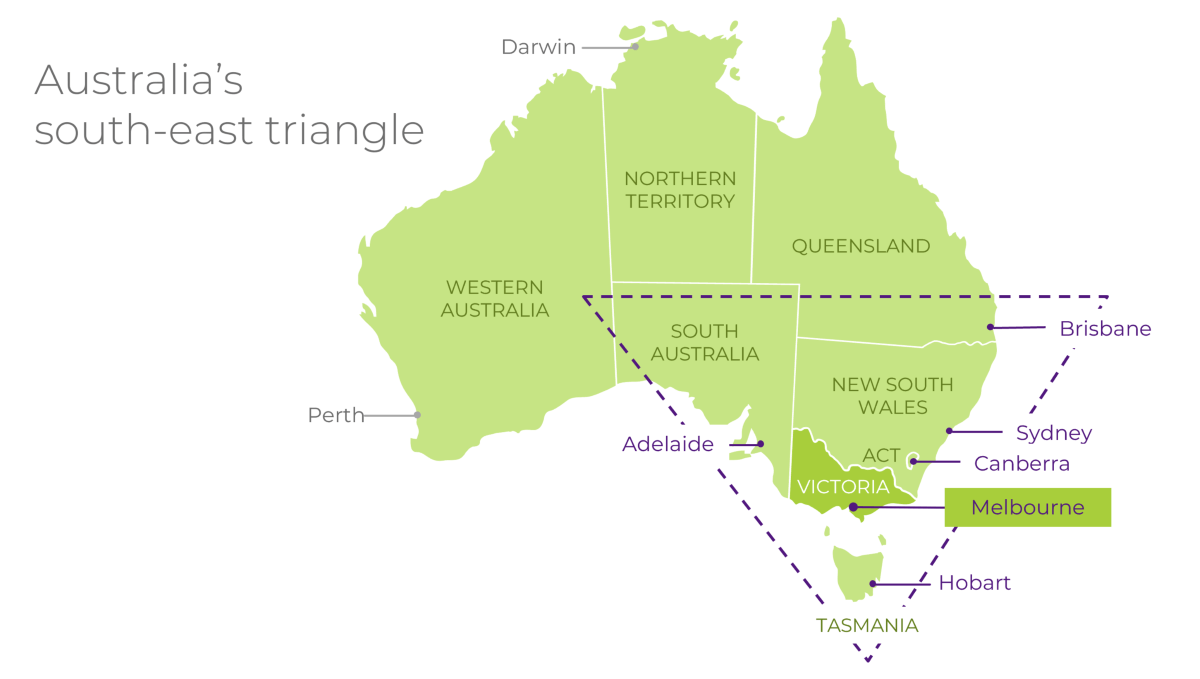
- Melbourne is located in the heart of the south-east triangle, a concentrated area that is responsible for 62% of Australia’s economic activity3 and is home to 68% of the population.4
- Melbourne is Australia’s largest city with over 5.2 million people (by Significant Urban Area).7
- Major regional and peri-urban centres account for about 25% of Victoria's population. Many of these population centres are within 2 hours of Melbourne by road or rail.
Strategic location
We sit in the middle of the Australian south-east triangle – a heavily concentrated area of economic prosperity.
On our doorstep is the Asia-Pacific region, home to over 4.7 billion people1 and a total economy of over US$40 trillion.2
We have identified Australia as a growth region, so we’re investing heavily by establishing Melbourne as our regional headquarters.
Business markets
Access more than 2.5 million Australian businesses, with 39% being employing businesses.
Melbourne has a strong reputation for innovation and entrepreneurship. The city's universities and research institutions foster a culture of creativity and innovation, attracting tech startups, biotech and agritech companies, and other knowledge-based businesses.
Companies operating in Australia
| Type of Business | No of employees | No of businesses | % of total |
|---|---|---|---|
| Non-employing | 1,585,693 | 61% | |
| Employing | 1-4 | 703,467 | 27% |
| 5-19 | 231,259 | 9% | |
| 20-199 | 64,559 | 2% | |
| 200+ | 4,895 | 0% | |
| Total employing | 1,004,180 | 39% | |
| Total | 2,589,873 | 100% |
Source: ABS 8165.0 Counts of Australian Businesses, FY2024
FAQs
Melbourne is Australia’s largest city with more than 5.2 million people, and Victoria’s population exceeds 7 million.
Strong population growth and a diverse, affluent consumer base create sustained demand for goods and services across sectors including retail, health, education and technology.
Over the past decade, Melbourne has added more than one million residents, supporting long-term market expansion.
Companies based in Melbourne can access over 2.5 million Australian businesses, creating significant opportunities for partnerships, supply chains and B2B sales.
Australia’s broader market includes 27.4 million people and an economy valued at more than US$1.77 trillion, providing a stable and sizeable domestic market for growth
Melbourne sits within Australia’s south-east economic corridor, where around 62% of the nation’s economic activity and 68% of its population are concentrated.
Businesses in Melbourne also benefit from proximity to the Asia–Pacific region, home to more than 4.7 billion people and a US$40 trillion economy, providing strong opportunities for international trade and expansion.
Sources
- World Economics, Asia Pacific Region 2024
- International Monetary Fund (2025), World Economic Outlook
- Australian Bureau of Statistics (2023-24), Australian National Accounts: State Accounts
- Australian Bureau of Statistics (December 2024), National, state and territory population
- Australian Bureau of Statistics (2023-24), Regional population
- Australian Bureau of Statistics, 2021 Census, Greater Melbourne
- Australian Bureau of Statistics (December 2024), National, state and territory population
